Licence to Let – Conversion-Focused Website for Short-Term Let Licensing
Връзка към проекта
Посетете сайтаКлиент
Licence to LetУслуги
Местоположение
Scotland & EnglandВремева рамка
2026Технологии и тактики
Спецификации
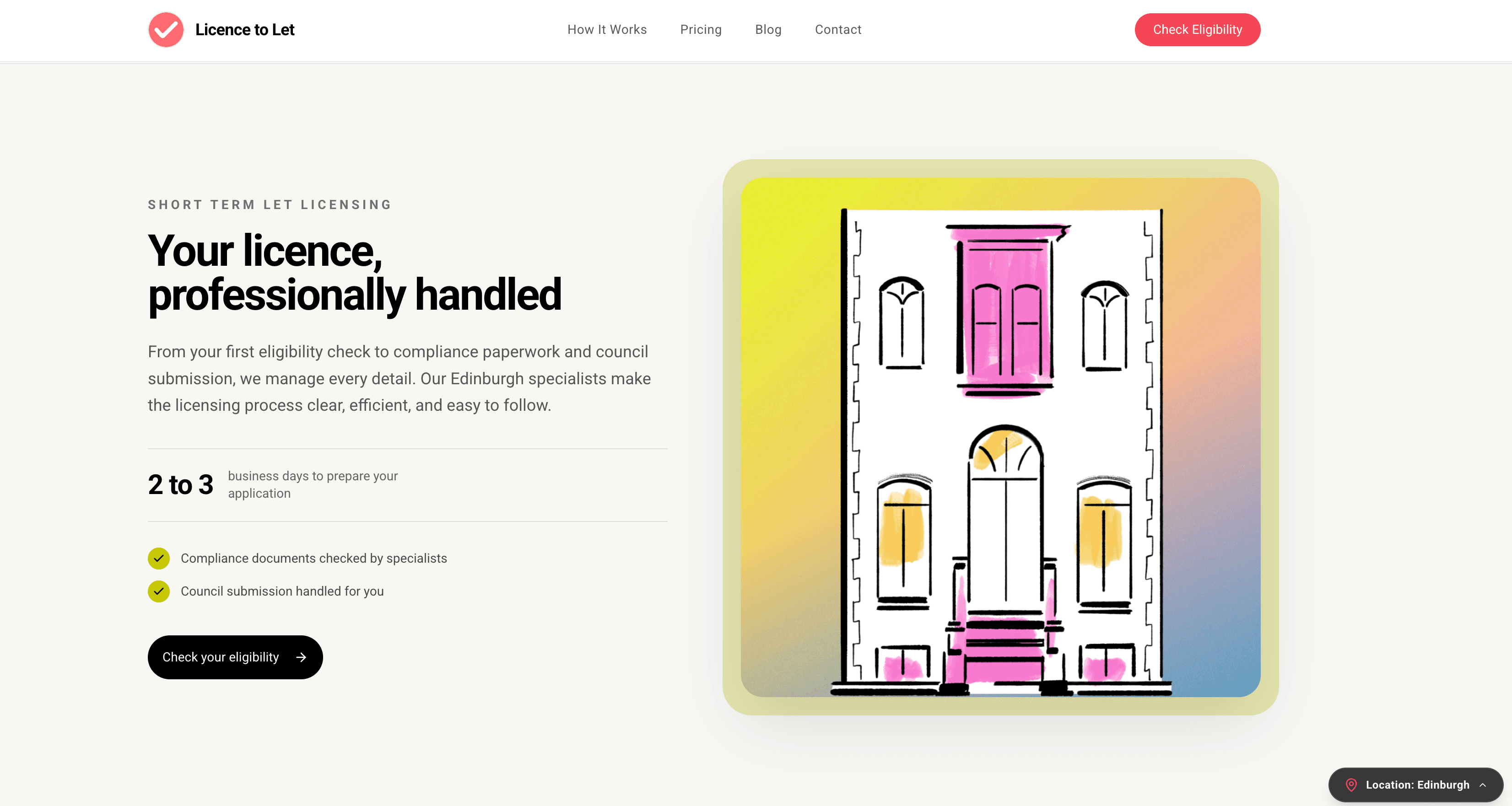
How Licence to Let moved from a basic one-page website with no contact form to a modern, conversion-focused platform built around location-specific licensing information, clearer customer journeys and scalable lead generation across Scotland and England.
Предизвикателството
Licence to Let provides specialist short-term let licensing, compliance and application support for property owners, landlords and accommodation operators.
Its previous website consisted of a single page with limited information about the company’s services. Visitors had no structured way to identify the support relevant to their property, location or licensing requirements.
There was also no contact form or guided enquiry process. The only clear route for potential customers was to contact the company directly through a message or external communication channel.
This created several problems.
Potential customers arriving from search engines, advertising campaigns or referrals had to work out for themselves:
Short-term let licensing requirements differ significantly according to location and property circumstances. A landlord in Edinburgh may face a very different process from an operator elsewhere in Scotland or a property owner seeking compliance support in England.
The original one-page website could not communicate these differences clearly. It also provided limited scope for search visibility because all services, locations and customer needs were compressed into a single page.
The challenge was therefore larger than giving the website a visual redesign.
Licence to Let required a complete digital platform that could:
Решението
We designed and developed a new conversion-focused website built around user intent, location-specific information and a clearer route from initial research to enquiry.
The platform was developed using Next.js, providing a fast, modern and scalable technical foundation while allowing each important service and location to have its own structured content and search presence.
1. Location-Based User Journey
One of the central requirements was ensuring visitors received information relevant to where their property was located.
Rather than presenting every user with the same general licensing content, the website introduces a location-led journey that helps distinguish between services and requirements across Scotland and England.
Visitors can identify the area relevant to them and access information covering local licensing requirements, available application support, compliance documentation, expected processes, temporary and full licence options, property-specific considerations, and the next steps for beginning an application.
This reduces confusion and prevents visitors from having to interpret information intended for a different region.
The structure also allows Licence to Let to expand into additional council areas and locations without repeatedly redesigning the website.
2. Conversion-Focused Information Architecture
The previous website placed all information on one page. We replaced this with a structured website architecture designed around how potential customers actually search and make decisions.
The new structure separates key areas such as short-term let licensing services, licensing support by location, temporary and seasonal licence requirements, full-year licensing, compliance certificates, application assistance, frequently asked questions, and contact or enquiry routes.
Each page has a clear purpose and is connected to the next logical action.
Visitors researching general licensing requirements can move naturally toward location-specific information, service details and a relevant enquiry form without having to return to the homepage or search through unrelated content.
3. Dedicated Enquiry and Contact System
A major limitation of the former website was the absence of a contact form.
We introduced clear, conversion-focused enquiry routes throughout the new website.
Instead of relying exclusively on direct messages, potential customers can now provide structured information about their property location, the type of short-term let, the licensing assistance required, their current compliance position, their intended operating dates, and the urgency of their application.
This gives the Licence to Let team more useful information before the first conversation and creates a more professional experience for the customer.
Calls to action are positioned at relevant decision points throughout the website rather than being confined to a single contact page.
This allows users to make an enquiry when they have received enough information to proceed.
4. Modern Conversion-Focused Design
The website was redesigned to present Licence to Let as a knowledgeable and established licensing specialist.
The visual system prioritises clear headings, concise service explanations, prominent calls to action, accessible content spacing, responsive layouts, trust-building information, simplified navigation, and consistent presentation across desktop and mobile devices.
Complex regulatory information is divided into manageable sections so visitors can understand the process without being confronted by large, difficult blocks of legal or technical content.
The design balances authority with accessibility. The subject matter remains professional and compliance-focused, while the interface avoids making the process feel unnecessarily complicated.
5. Search-Optimised Location and Service Pages
The previous one-page structure gave Licence to Let limited opportunities to rank for the range of services and locations it covers.
The new website provides a scalable search architecture with dedicated pages aligned to relevant customer searches.
These pages can target combinations involving short-term let licensing, local licensing support, temporary short-term let licences, landlord compliance requirements, licensing application assistance, safety certificates, Scotland-specific regulations, England-specific services, and individual cities or council areas.
The objective was not to create repetitive pages with only the location name changed. Each location page is structured to provide information relevant to the user’s actual licensing circumstances, available services and expected process.
Technical SEO foundations were also incorporated through structured page metadata, clean URL architecture, internal linking, semantic headings, crawlable content, structured data where appropriate, canonical configuration, sitemap support, and performance-focused rendering.
6. Built for Paid Advertising and Campaign Landing Pages
Licence to Let already uses paid social campaigns to generate short-term let licensing enquiries. The new platform was designed to support those campaigns more effectively.
Advertising traffic can now be directed to pages that closely match the user’s location, licence type or immediate need rather than sending every visitor to the same general homepage.
This creates stronger alignment between advertising message, landing-page content, service explanation, qualification questions, and the final enquiry action.
The website also provides a stronger foundation for future campaign-specific landing pages without requiring separate external page builders or disconnected microsites.
7. Performance-Efficient Next.js Development
The website was developed using Next.js to provide a modern, maintainable and performance-focused application.
The technical approach supports fast page delivery, optimised image handling, responsive rendering, reusable content components, scalable location templates, efficient metadata management, server-side and static rendering where appropriate, and straightforward expansion into new regions.
The platform is structured so new services and locations can be introduced without rebuilding the core website. This is particularly important for Licence to Let because licensing requirements and service coverage may continue to develop across the UK.
8. Environmentally Conscious Hosting and Infrastructure
Performance and sustainability were considered together during the technical build.
The website was designed to minimise unnecessary page weight, processing and asset delivery through efficient frontend components, optimised images, reduced unnecessary JavaScript, reusable layouts, caching, streamlined page rendering, and infrastructure selected with efficient content delivery in mind.
A faster and lighter website does not only improve the user experience. It can also reduce the amount of data transferred and computing resources required to serve each visit.
Rather than adding unnecessary visual effects or resource-heavy functionality, the platform focuses on delivering the information users need through a clean and efficient interface.
9. Scalable Content and Regional Expansion
The new website is not limited to Licence to Let’s current pages.
Its architecture allows the company to add new cities, new council areas, additional licensing services, compliance partners, new application types, educational resources, campaign landing pages, and revised regulatory guidance.
Location data, service information and reusable page components can be expanded while maintaining consistent design and conversion journeys.
This gives Licence to Let a long-term platform rather than another temporary brochure website.
Резултатите
The new website transformed Licence to Let’s digital presence from a limited one-page information page into a structured customer acquisition and service platform.
Key improvements include:
- Clearer Regional Journeys: Visitors can access information relevant to Scotland, England or their selected location rather than interpreting generic UK-wide content.
- Dedicated Enquiry Process: Potential customers now have a structured method of contacting Licence to Let and providing meaningful information about their property and licensing requirements.
- Improved Lead Qualification: Location, service and compliance information can be captured earlier, helping the team understand each enquiry before beginning direct follow-up.
- Stronger Conversion Opportunities: Calls to action and enquiry routes are positioned throughout the user journey rather than relying on a single direct-message option.
- Expanded Search Visibility: The website can target individual services, locations and licensing needs through dedicated search-optimised pages.
- Better Advertising Alignment: Paid traffic can be directed to relevant landing pages based on location, licence type and campaign message.
- Modernised Brand Presentation: The new interface presents Licence to Let as a specialist, credible and established licensing support provider.
- Improved Mobile Experience: Responsive layouts make complex licensing information easier to access and understand across mobile devices.
- Performance-Focused Infrastructure: The Next.js build, optimised assets and efficient delivery structure provide a faster and lighter browsing experience.
- Scalable Technical Foundation: Licence to Let can add new locations, services and regulatory information without rebuilding the platform.
The project replaced a restricted one-page website with a modern digital system built around clarity, conversion and long-term growth.
By combining location-specific information, structured service content, clear enquiry routes and performance-efficient development, Licence to Let now has a website capable of supporting organic visibility, paid acquisition and regional expansion across Scotland and England.
Искате уебсайт като този?
Свържете се с нас, за да обсъдим как можем да изградим бърз, сигурен и изцяло оптимизиран уебсайт за вашия бизнес.