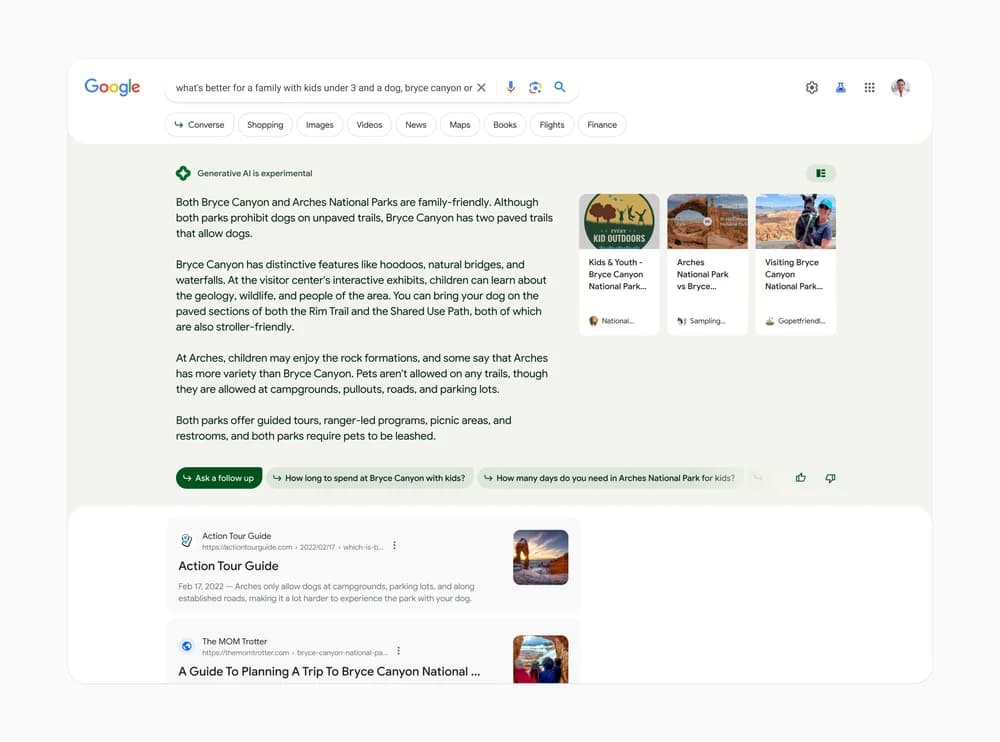
Reference
SXE is often misunderstood.
Some treat it as:
- a UX checklist
- a Core Web Vitals exercise
- a CRO rebrand
- a design problem
None of these are correct.
SXE - Search Experience Optimisation - is about whether a search engine believes a result satisfied the user’s intent.
In an AI-first SERP, that belief now matters more than the click itself.
This guide explains:
- what SXE actually means in 2026
- how satisfaction is inferred
- why clicks matter less than outcomes
- how SXE connects SEO, GEO, UX, and content
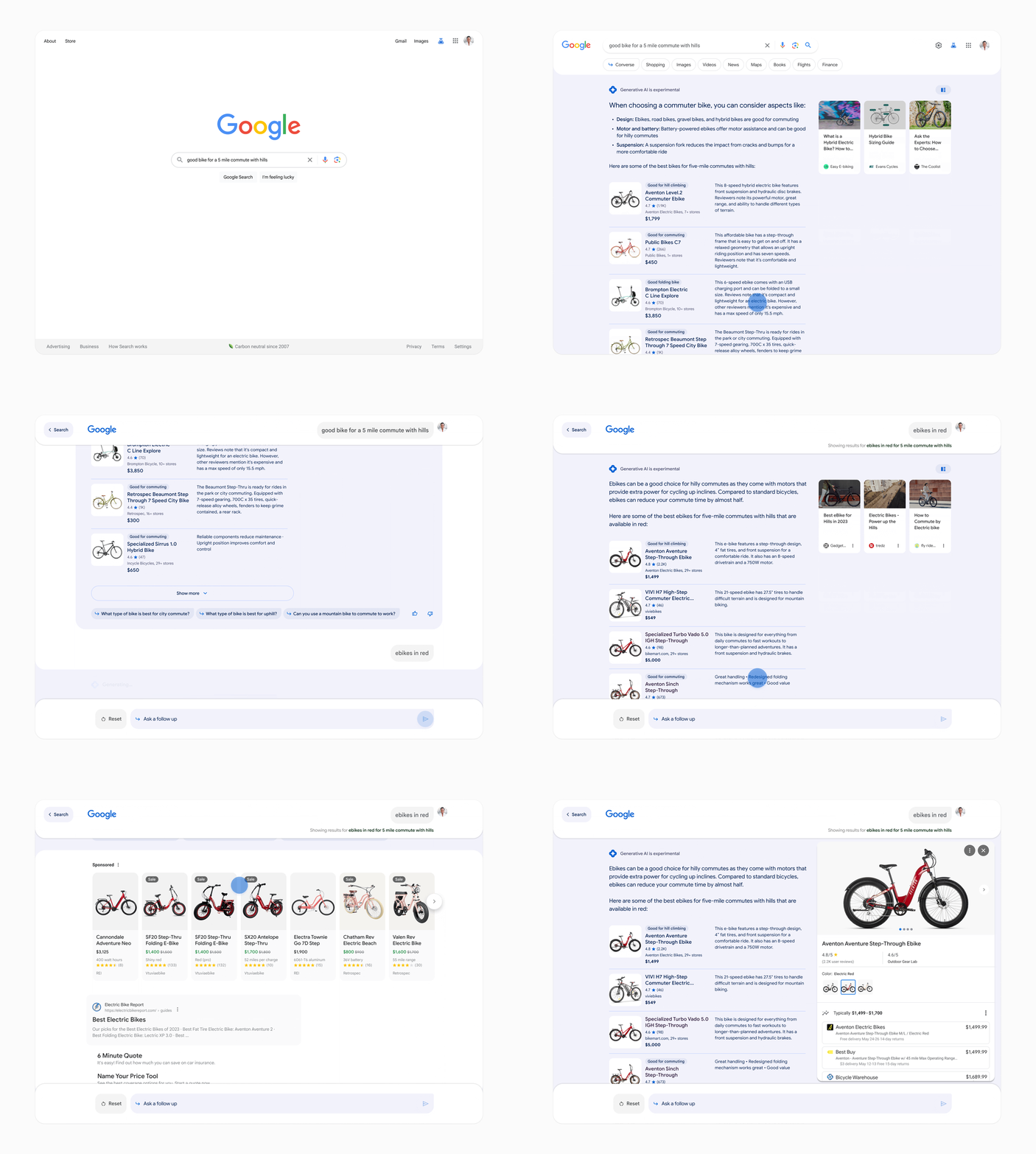
Source: Google
If you’re exploring how AI is reshaping the SERP, start with the zero-click shift and how to think about SEO metrics after AI Overviews.
Why SXE matters more now than ever
Historically, search engines relied heavily on:
- clicks
- dwell time
- pogo-sticking
- basic engagement signals
AI changes the equation.
Now, systems:
- model intent more accurately
- infer satisfaction probabilistically
- compare outcomes across journeys
- reduce reliance on any single signal
SXE is the layer where all of this converges.
SXE is not “optimising for less clicks”
A common fear is:
“If AI answers users directly, experience doesn’t matter.”
The opposite is true.
When clicks happen less often:
- each click carries more weight
- satisfaction signals become stronger
- poor experiences stand out faster
SXE is not about getting the click.
It is about justifying it.
What “satisfaction” actually means
Satisfaction is not a metric.
It is inferred from patterns such as:
- whether users return to search
- whether they refine queries
- whether they search the brand later
- whether journeys progress smoothly
- whether outcomes align with intent
No single signal defines satisfaction.
Search engines model it holistically.
SXE vs UX vs CRO
These are related but not interchangeable.
UX
- usability
- accessibility
- design clarity
CRO
- conversion efficiency
- persuasion
- funnel optimisation
SXE
- intent fulfilment
- expectation matching
- journey coherence
- outcome alignment
A page can convert well and still fail SXE if it mismatches search intent.
If you want to improve outcomes without creating friction, treat SXE as the layer that connects SEO and CRO - not a replacement for either.
Why AI increases the importance of intent matching
AI systems:
- understand query nuance better
- detect intent mismatches faster
- correlate outcomes across users
If a page ranks but:
- answers the wrong question
- delays clarity
- buries the point
- over-sells
The system learns quickly.
Ranking without satisfaction is unstable.
SXE and content clarity
Content that performs well for SXE:
- states the answer early
- explains reasoning clearly
- sets expectations honestly
- acknowledges limits
- avoids unnecessary friction
This does not mean:
- shallow answers
- oversimplification
- removing depth
It means respecting the user’s reason for searching.
Page experience still matters - but not alone
Performance, layout, and accessibility still matter because:
- frustration weakens satisfaction
- slow pages increase abandonment
- instability erodes trust
However:
- perfect Core Web Vitals cannot save poor intent matching
- great design cannot compensate for unclear answers
SXE is additive, not substitutive.
SXE in informational vs transactional queries
Informational queries
SXE depends on:
- clarity
- completeness
- neutrality
- trustworthiness
Over-selling harms satisfaction.
Transactional queries
SXE depends on:
- speed to value
- confidence
- friction reduction
- clear next steps
Over-explaining harms satisfaction.
Context matters.
SXE and AI Overviews
AI Overviews act as a pre-filter.
When users click through:
- expectations are higher
- patience is lower
- satisfaction thresholds are stricter
If your page:
- contradicts the AI answer
- adds no value
- feels redundant
SXE fails immediately.
Your page must extend, not repeat.
For the paid side of this shift (and what “ads in AI answers” might mean), see Ads in AI Overviews.
Internal consistency and SXE
SXE is evaluated across journeys, not pages.
Problems arise when:
- pages contradict each other
- navigation is unclear
- messaging shifts mid-journey
- expectations are reset repeatedly
Consistency reduces cognitive load.
Lower cognitive load improves satisfaction.
Measuring SXE without chasing ghosts
You cannot measure SXE directly.
You can observe proxies:
- query refinement rates
- assisted conversions
- branded search lift
- return visits
- stability of rankings over time
SXE shows up as resilience, not spikes.
Common SXE mistakes
- Optimising purely for engagement metrics
- Chasing time-on-page artificially
- Overloading pages with CTAs
- Treating all queries the same
- Designing for clicks instead of outcomes
These create friction, not satisfaction.
A practical SXE mindset for 2026
For every important page, ask:
- What problem brought the user here?
- What would “done” look like for them?
- Are we helping or delaying?
- Are we honest about limitations?
- Would this feel satisfying if AI already summarised the basics?
These questions guide better decisions than any checklist.
SXE as the unifying discipline
In an AI-first SERP:
- SEO earns visibility
- GEO earns selection
- UX enables clarity
- CRO enables action
- SXE validates the whole journey
SXE is not a channel.
It is the quality bar everything else is judged against.
Summary
SXE is no longer optional.
As AI reduces noise and compresses journeys, satisfaction becomes the signal that endures.
In 2026, the sites that win are not the ones that:
- extract the most clicks
- push the hardest
- optimise the loudest
They are the ones that:
- respect intent
- reduce friction
- deliver clarity
- and let users leave feeling finished
That is what search engines are learning to recognise - and reward.
Related reading
Glossary terms
Want help applying this?
Get a baseline audit, explore the most relevant service, or use a tool to validate your next move.
Related Resources

Kiril Ivanov
Managing Director & Performance Lead
Kiril Ivanov is a digital marketing specialist with experience managing local, national and international campaigns for businesses ranging from growing independent companies to major consumer brands. His background includes leading advertising automation work for Michael Kors and working on campaigns involving Canon, Dormeo, esure, DLG Group, Village Gym, Cameron House, Crerar Hotels, Cromlix Hotel, Harrison Fund and the Advertising Standards Authority. His experience spans paid search, paid social, advertising automation, SEO, conversion optimisation and wider digital strategy across hospitality, retail, financial services, professional services and other competitive sectors.
View author profile →